
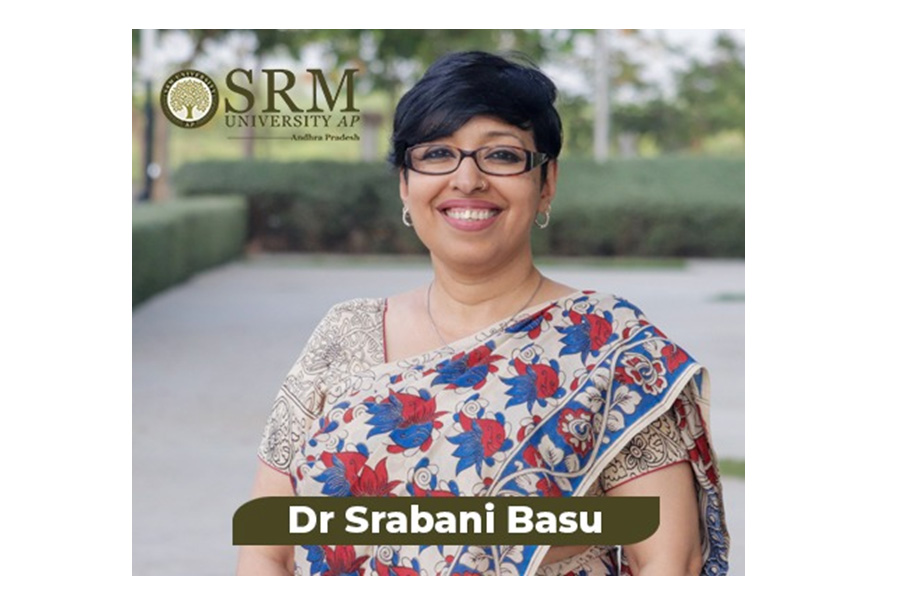
By-DR SRABANI BASU, ASSOCIATE PROFESSOR, DEPARTMENT OF LITERATURE AND LANGUAGES, EASWARI SCHOOL OF LIBERAL ARTS, SRM UNIVERSITY AP
Nana bhasha, nana mat, nana paridhan,
Bibidher majhe dekho milan mahan…
“Many languages, many beliefs, many forms of attire; behold the great confluence within diversity.”
These lines from Atul Prasad Sen’s celebrated Bengali patriotic song Hao Dharmete Dheer could almost have been written as a description of India itself. India has never been a single story. It is an argument, a memory, a song, a contradiction, a thousand kitchens, innumerable gods and several ways of questioning them. It speaks in many languages and dreams in many more. Perhaps, therefore, the question is not whether different Indians can become the same. They cannot, and perhaps they should not. The more interesting question is whether, despite our differences, we can remain in the same conversation. And this is where literature enters—not as an answer, but as a meeting place.
Literature has always done something remarkable: it allows us to enter a life that is not ours without demanding that we surrender our own. I do not have to be a nineteenth-century Bengali woman to feel the suffocation of Tagore’s women. One does not have to belong to a Dalit community to be disturbed by the world that Bama opens before one in Karukku. One need not inhabit the partitioned Punjab of 1947 to understand the madness that Saadat Hasan Manto compresses into the unforgettable figure of Bishan Singh in Toba Tek Singh. One does not have to live in Malgudi to recognise R. K. Narayan’s people. Literature performs this quiet miracle every day: it takes the unfamiliar and places it close enough for us to hear its heartbeat.
Perhaps that is particularly important in India because our differences are not decorative. They are real. Language, caste, class, religion, gender, geography, food, memory and history shape the worlds we inhabit. The India of Premchand is not the India of Vaikom Muhammad Basheer. Mahasweta Devi’s landscape is not Amitav Ghosh’s, just as the world of Ismat Chughtai does not resemble that of Ruskin Bond. Yet when these writers occupy the same bookshelf, something extraordinary happens. India begins speaking to itself.
And it does not always speak politely.
That may be literature’s greatest contribution to a democracy. A meaningful conversation is not one in which everyone agrees. It is one in which disagreement does not automatically become erasure. Literature has never required unanimity. Kabir can question religious orthodoxy; Mirabai can walk out of the identities prescribed to her; Ambedkar can force us to confront the brutality embedded within social structures; Manto can refuse to make Partition morally convenient; Mahasweta Devi can place before us people whom respectable society has learned not to see. Literature does not necessarily make us comfortable with one another. Sometimes it does precisely the opposite. It unsettles our comfortable versions of ourselves.
And perhaps we need that unsettling.
We often speak of India through the phrase “unity in diversity.” It is a beautiful phrase, but familiarity has almost polished away its difficulty. Diversity is easy to celebrate when it appears as cuisine, costume, music or festival. It becomes much harder when diversity speaks in a voice that disagrees with us. Can we listen then? Can a person from one caste read the humiliation experienced by another without immediately becoming defensive? Can someone from one religious community enter the fears and memories of another? Can a metropolitan reader encounter the realities of a tribal community without reducing it to an exotic footnote? Can a man read a woman’s anger without rushing to explain it to her? Literature cannot guarantee that we will. But it can create the possibility.
The reason is simple. Statistics inform us; stories implicate us.
A report can tell us that millions were displaced during Partition. Literature gives us a Bishan Singh standing on a piece of land that seems to belong to neither country. History tells us about colonialism; literature allows us to hear the voices that lived within and against it. Sociology may explain caste; literature can make us sit beside someone experiencing its everyday violence. A newspaper tells us what happened. A story sometimes asks the more uncomfortable question: what did it feel like when it happened?
That shift, from knowing about another person to imaginatively entering another person’s world, is the beginning of conversation.
Language, of course, makes the Indian literary conversation particularly fascinating. We do not possess one Indian literature but a vast constellation of literatures: Bengali, Tamil, Telugu, Malayalam, Hindi, Urdu, Assamese, Marathi, Kannada, Odia, Punjabi and many others, including powerful oral traditions that long preceded print. Each language carries memories that cannot be perfectly transported into another. Something is inevitably lost in translation. But something is also gained: a door opens.
Translation may therefore be one of the most important acts of cultural hospitality in India. When a Malayalam novel reaches a Bengali reader, when a Tamil poem travels into English, when an Assamese story is read in Telugu, literature crosses a border without requiring anyone to surrender a passport. Translation says: Come into my world. You may not understand every word exactly as I do but come anyway.
Perhaps that invitation matters today more than ever.
We live in an age of extraordinary communication and increasingly narrow conversations. Technology has connected us, but connection does not necessarily produce encounter. Algorithms often return our own preferences to us. We read people who think like us, follow people who resemble us and sometimes block those who disturb the architecture of our certainty. We may inhabit the same country while living inside entirely different informational realities. The danger is not merely that Indians disagree. Indians have always disagreed, gloriously and noisily. The danger begins when we stop being curious about why the other person sees the world differently.
Literature interrupts that certainty because a good book is an extended encounter with another consciousness.
For a few hundred pages, we cannot simply swipe the other person away.
This is why literature must remain central to education, not because every student needs to become a literary scholar, but because every citizen needs practice in inhabiting complexity. Reading Shakespeare, Tagore, Premchand, Bama, Manto, Mahasweta Devi, Basheer or contemporary voices from different parts of India is not merely an academic exercise. It is an exercise in expanding the boundaries of the self. Literature teaches us to ask, “What does the world look like from where you stand?” That question may be one of the foundations of a plural society.
But literature should not be romanticised either. Reading does not automatically make someone compassionate. History contains enough well-read people who were perfectly capable of cruelty. A book cannot manufacture empathy like a product on an assembly line. What literature can do is create an opening. It can disturb prejudice, complicate stereotypes and place a question mark where previously there was a full stop. What we do with that opening remains our responsibility.
Perhaps, then, literature cannot bring all Indians into the same opinion. Nor should it try. India would become intellectually impoverished if its many voices were reduced to one agreeable chorus. What literature can offer is something far more valuable: the same conversational space, a space where Kabir may sit beside Tagore, where Ambedkar may challenge inherited structures, where Manto may disturb official histories, where a voice from Kashmir may be heard beside one from Kerala, and where stories from villages, cities, forests, margins and metropolises may refuse to remain strangers to one another.
Atul Prasad Sen did not write, Bibidher majhe dekho ekota: look for sameness amid diversity. He wrote, Bibidher majhe dekho milan mahan: look for the great mingling, the great confluence, within diversity.
There is a profound difference.
A confluence does not require rivers to lose the journeys that brought them there. They arrive carrying different soils, different landscapes and different memories. They meet, mingle, resist, reshape one another and continue flowing.
Perhaps India is such a confluence.
And perhaps literature is one of the places where we can still arrive as different rivers, carrying different histories, languages, wounds, laughter, gods, doubts and dreams and sit, for a while, on the same page. There is no desperation to agree but one can read and listen. And, most importantly, remaining in the conversation.
Rumi wrote:
Az kufr-o ze Islām borun ṣaḥrāyi-st,
Mā rā be miyān-e ān fazā sowdāyi-st.
He once imagined a place beyond the territories of right and wrong, a field in which human beings could meet. Perhaps literature is one such field. We enter it carrying our identities, our certainties and our differences, but somewhere between one page and the next, we encounter someone whose world is not ours. And if we stay long enough to listen, the stranger acquires a voice.
Perhaps that is all literature can promise a country as magnificently argumentative and impossibly plural as India; not that we shall speak in one voice, but that we shall not stop speaking to one another.
